
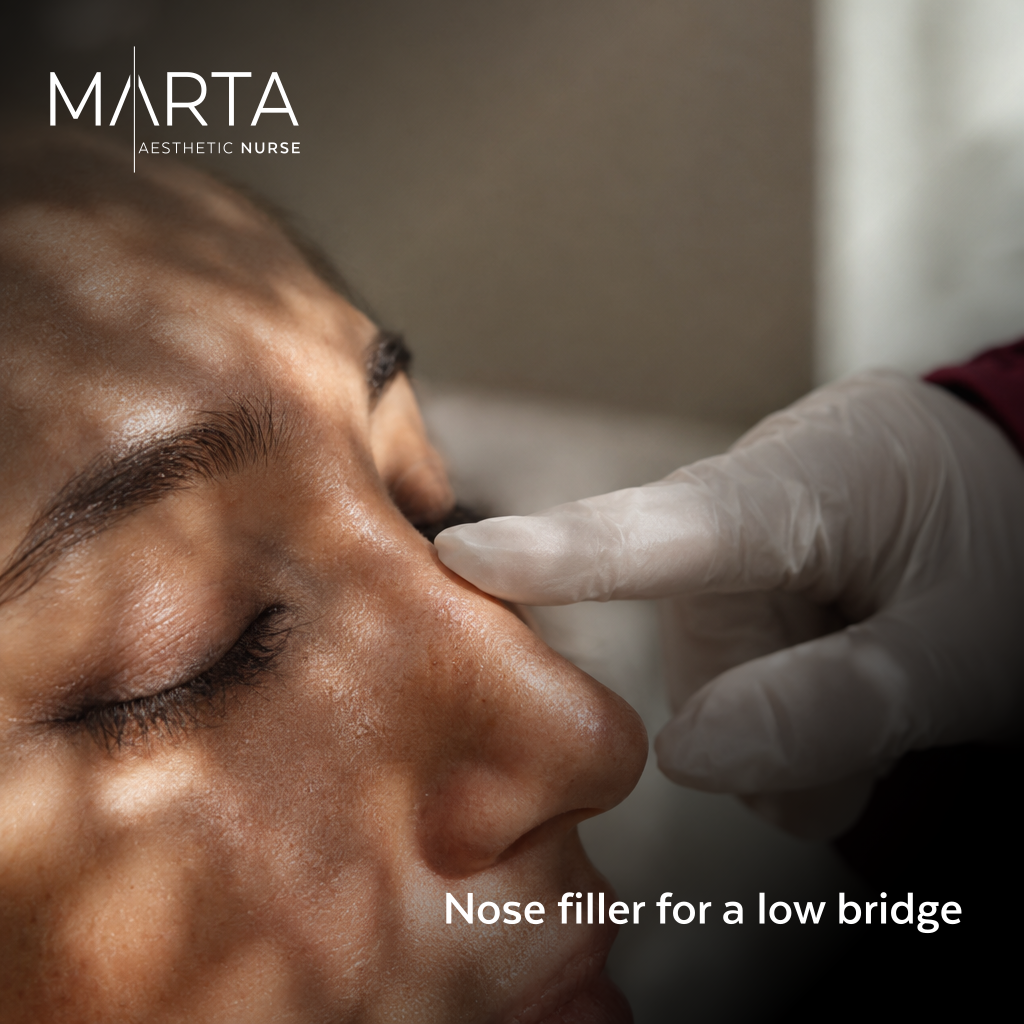
How Added Structure Can Refine Your Profile
If you have a low nasal bridge, you may be looking for a smoother, straighter line in profile, with subtle definition that still looks like you. For many people, that goal is less about “changing” their nose and more about adding support so the bridge reads more balanced from the side.
In the medical literature, the most common non-surgical rhinoplasty (NSR) use with dermal fillers is “fixing and creating a smooth nasal bridge,” also called dorsal augmentation. This matters for expectations, because nose filler works through small, strategic additions that change the surface line you see.
Clients across Toronto, Vaughan, and the GTA often ask the same question before booking: what can nose filler add for a low bridge, and what should you be cautious about. The answer starts with understanding what structural “addition” can do, and where the limits are.
What Nose Filler Can Add for a Low Bridge
A low bridge concern is usually a profile concern. You want the bridge to look smoother, straighter, and more supported when you turn to the side. NSR is commonly described as shaping and contouring the nose, and in a systematic review in Cureus, dorsal augmentation is described as the most common procedure performed with dermal fillers.
Because the change comes from adding support, the most realistic goal is often improved balance and a cleaner bridge line in profile. The same Cureus review frames NSR as an alternative option for minor nasal abnormalities, which is a useful way to think about candidacy.
How Added Structure Changes the Visible Line
Non-surgical rhinoplasty using hyaluronic acid (HA) filler changes shape by placing small amounts of gel at specific points, so the surface line appears straighter and more even. This “build around it” approach can camouflage certain irregularities by supporting the line of the bridge rather than trying to make the nose smaller.
A practical decision point follows from that: if your main wish is a meaningful reduction in size or a surgical-style change, it is worth pausing and discussing whether NSR fits the goal, because the literature positions NSR for mild-to-moderate or minor deformities rather than major change.
Off-Label Use Is Part of the Conversation
A peer-reviewed review on PMC states plainly that use of any dermal filler in the nose is off-label, and that patients should be advised accordingly. In clinic, that means a non-surgical rhinoplasty with filler consultation needs to include clear, direct consent around how the product is being used.
Why Conservative Amounts and Staging Matter
The nose is a high-stakes area. It has thin soft tissue and important blood vessels, and the safety discussion in the literature reflects that. A careful approach is not only about aesthetics. It is also about managing risk and giving you a result that still looks natural on your face.
What Product Labelling Warns About Overcorrection
Manufacturer Directions for Use for Juvéderm® VOLUMA® with Lidocaine include an explicit warning: “Do not overcorrect.” The same document adds, “Do not overcorrect as injection of an excessive volume can be at the origin of some side effects such as tissue necrosis and oedema.”
That matters for your decision because the bridge can look different while swelling settles, and because “more” is not a neutral choice in this area. Conservative additions help protect the refined look many clients want, where the bridge looks supported without looking heavy.
Why a Staged Plan Can Protect Your Result
Staging is a practical way to respect how noses heal and how small asymmetries show up. The Juvéderm® VOLUMA® with Lidocaine DFU recommends waiting until side effects are resolved, with a minimal interval of 2 weeks, between two injections. While this guidance is general and not written specifically for noses, the underlying logic is relevant to how swelling and bruising can temporarily disguise the final contour.
For you, a staged plan can reduce the pressure to decide everything in one sitting. It also creates a natural checkpoint: once early swelling settles, you and your injector can reassess whether more product supports your goal or whether stopping earlier keeps the result better balanced.
Who Should Pause Before Nose Filler
Good outcomes in NSR start with selecting the right goal for the right anatomy. Two situations come up often in consults: recent nasal trauma or procedures, and goals that require reduction rather than structural addition.
Recent Trauma, Surgery, Scarring, Multiple Treatments
Canadian Society of Aesthetic Specialty Nurses (CSASN) practice guidance lists risk factors for vascular occlusion, including previous surgeries and multiple treatments, and scars. If you have had recent nasal trauma, recent nasal procedures, or significant scarring, it is a reasonable point to pause and discuss timing and risk in a patient information and care style consult, rather than rushing into a plan.
Goals That Require Size Reduction
NSR is described in the literature as a way to correct minor issues and to reshape mild-to-moderate deformities. It is also commonly described in terms of dorsal augmentation, meaning adding support to create a smoother bridge line. If your goal is meaningful reduction, it is worth having a candid conversation about fit, because your most satisfying outcome depends on matching the method to the outcome you have in mind.
How Results Can Settle, and How Long They May Last
Plan for a “settling” phase. Even if the bridge line looks improved immediately, early swelling or bruising can change what you see in the first days, and it can temporarily blur fine contour details.
Early Settling and Temporary Effects
A peer-reviewed PMC review states that mild bruising, ecchymosis, and edema can be seen after NSR. For many clients, the most useful mindset is to treat the early look as a work in progress, then judge the shape once swelling and bruising have resolved.
Duration Ranges Reported in Reviews
On duration, published summaries vary. The Cureus systematic review states NSR can produce effects that persist between eight months and a year, with repeat treatment around one year later suggested to maintain outcomes. In the same paper, the authors note follow-up periods in included studies were relatively short, which limits long-term assessment.
A separate narrative review on PMC reports that duration of effect for HA products is reported to range from 6 months to 18 years depending on the product and site of injection, and it adds that in the nose, multiple authors report duration of treatment up to 8 years after a single injection. This is review-level reporting that cites multiple authors, rather than a single trial outcome.
Risks to Understand, and What to Watch For
NSR can be a thoughtful option for the right goal, but it deserves an adult conversation about risk. The nasal area has critical blood supply, and major complications are described in the medical literature.
What Published Complication Rates Look Like
The PMC review reports that in a systematic review and meta-analysis of 37 publications with 8604 patients undergoing NSR, DeVictor et al. reported an overall complication rate of 2.52%. Bruising, at 1.58%, was the most common complication. Major complications reported included transient vessel occlusion (0.35%), vision loss (0.09%), and skin necrosis (0.08%). Infection and nodule formation were each reported at 0.07%, and granuloma and anaphylaxis were reported at a rate of less than 0.01% each.
Serious Risks and Immediate Red Flags
The same PMC review states that major complications include vascular compromise, skin ischemia and necrosis, and vision loss and stroke. For a clear example of symptom urgency language from a regulator, the U.S. FDA advises providers to immediately stop injection if a patient has signs associated with injection into a blood vessel, and it warns patients to seek immediate medical attention for symptoms including vision changes and signs of a stroke. This FDA messaging reflects U.S. regulatory guidance.
For you as a patient, the key practical takeaway is simple: nose filler is not a “casual” injectable. Choose an injector who treats safety, assessment, consent, and follow-up as part of the service, and who is prepared to act quickly if a complication is suspected.
Questions Worth Asking at Your Consult
A good NSR consult is specific to your anatomy and your goal, and it should include straight talk about limits. Marta’s approach is anatomy-first aesthetic care, which means the plan starts with how your whole face reads, not a single angle.
- “Is my goal mainly bridge smoothing and support, or am I hoping for reduction?”
- “How do you decide whether this is a minor correction that NSR can address?”
- “How do you stage treatment, and when would you reassess?”
- “What complications do you watch for, and what is your follow-up plan if something looks off?”
If you are also balancing multiple features, a full-face plan can matter more than a single syringe choice. You can ask how nose work fits into facial harmonization, especially if your goal is overall profile balancing rather than a standalone change.
Nose filler for a low bridge can add visible support and a smoother bridge line in profile, when the goal is a minor, structure-added refinement and the plan is conservative. The same decision also requires clear consent around off-label use, a realistic match between goal and method, and a calm understanding of both temporary settling and serious risks.
Questions Clients Often Ask
What can nose filler add for a low bridge?
It can add subtle support so the bridge line looks smoother and more balanced in profile. A Cureus review describes dorsal augmentation as the most common NSR use.
Is nose filler considered off-label?
A peer-reviewed review on PMC states that use of any dermal filler in the nose is off-label, and patients should be advised accordingly.
Why do injectors talk about using conservative amounts and staging?
A product DFU warns, "Do not overcorrect," and notes excessive volume can be linked to tissue necrosis and oedema. Staging also allows reassessment after swelling settles.
What short-term settling can happen after NSR?
A PMC review reports mild bruising, ecchymosis, and edema can be seen after NSR, which can temporarily affect how the bridge looks.
What risks should I understand before booking?
A PMC review describes major complications including vascular compromise, skin ischemia and necrosis, and vision loss and stroke. It also reports meta-analysis rates including 2.52% overall complications.

Marta Morozova, RNFounder of Aesthetic Nurse Marta, Vaughan
If you want to explore whether non-surgical rhinoplasty fits your profile goals, the next step is a personalized aesthetic consultation at Aesthetic Nurse Marta in Vaughan, at 7777 Weston Rd unit 102, Toronto (Vaughan–Woodbridge area), with ground-level access and on-site parking.
Ready to discuss nose filler? Request a consultation with Aesthetic Nurse Marta.
7777 Weston Rd, Unit 102, Vaughan, ONFor clients in Vaughan, Woodbridge, Toronto and Richmond Hill
Every treatment starts with an in-person assessment, and results differ from person to person. This article is general information, not medical advice.


