
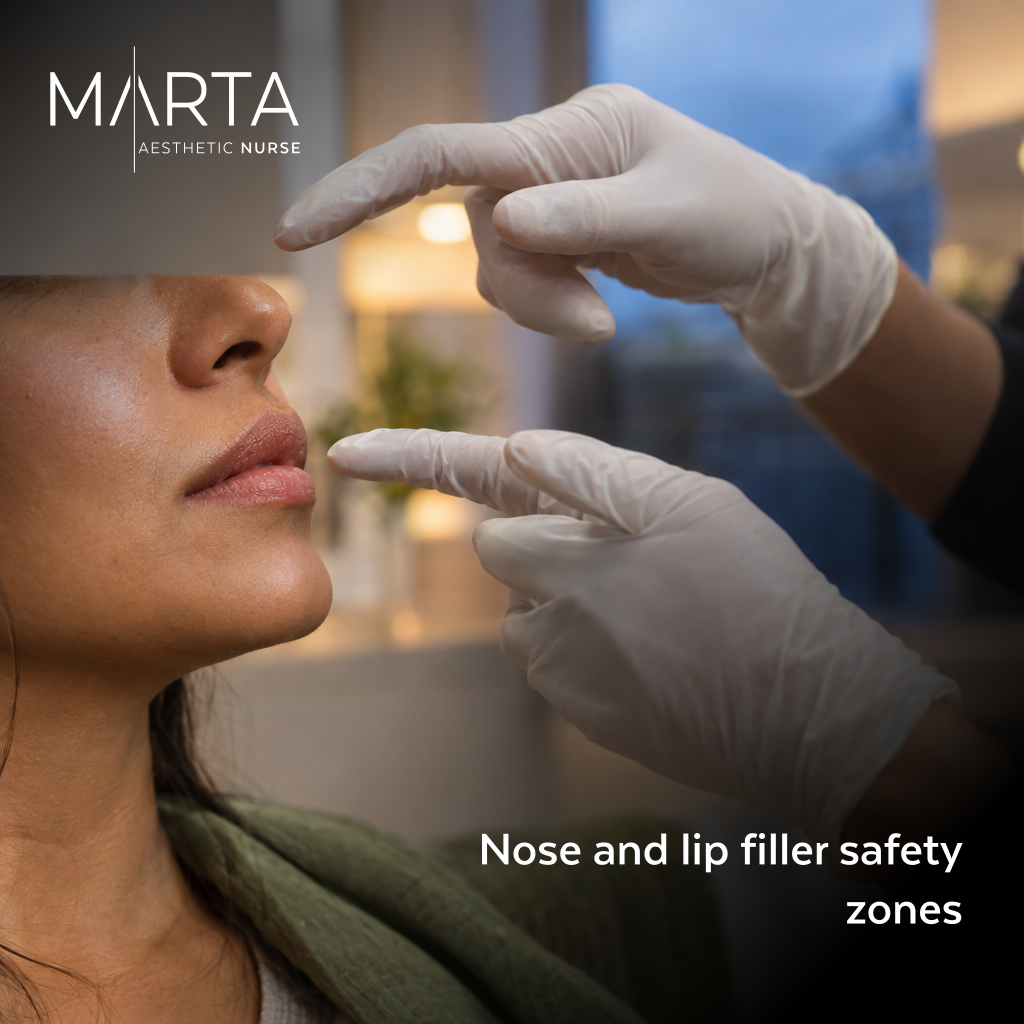
Questions That Show Safety Planning
If you are considering nose filler or lip filler, “safety zones” can sound like a map your injector either has or does not have. In real appointments, safety comes through the decisions your injector makes, the way they inject, and how ready the clinic is to recognize and respond if something looks wrong.
A 2026 narrative review in Dermatologic Surgery focuses on high impact facial regions, including the nose and lips, and ties safer outcomes to region specific vascular anatomy knowledge, individualized product and plane choices, and conservative technique such as slow, low pressure injection in small aliquots. Those themes translate directly into the questions you can ask before you commit, including here in the GTA, across Toronto and Vaughan.
This article turns those review principles, plus Canadian guidance from Health Canada and the Canadian Society of Aesthetic Specialty Nurses (CSASN), into a practical checklist for your consultation.
What Safety Zones Really Mean for Nose and Lip Filler
The nose and lips are high impact areas where small changes are very visible. They are also areas where technique and anatomy matter because the possible risks in high risk regions described in the Dermatologic Surgery review range from contour irregularities to tissue necrosis, vision loss, and embolic events.
For a client, a “safety zone” is less about a single safe spot and more about how your injector plans around region specific vascular anatomy, chooses an appropriate depth, and uses a conservative approach to placement and volume. The same review highlights prevention, early recognition of vascular compromise, and access to complication management protocols as essential.
ChecklistNose and lip filler safety questions
Plan and technique
- Which plane (depth) are you aiming for, and why?
- How does desired projection affect product choice?
- Do you inject slowly, at low pressure, in small aliquots?
- How do you keep volumes conservative in high impact areas?
Readiness and follow-up
- How do you recognize vascular compromise early?
- What complication management protocol do you have access to?
Questions That Show How Your Injector Plans Depth and Product
Nose filler safety and lip filler safety depend on decisions made for your face, not a one size approach. The 2026 Dermatologic Surgery review emphasizes individualized product selection according to multiple factors such as treatment plane, skin thickness, tissue mobility, desired projection, and filler rheology.
Start With Depth (the Plane)
If you only ask, “How much filler will I need,” you miss the more safety relevant question: where, anatomically, the product is intended to sit. The review specifically calls out “appropriate depth” as a safety principle.
- “Which treatment plane are you aiming for in my lips or nose, and what is driving that choice?”
- “How does my skin thickness and tissue mobility change your plan?”
- “Which region specific vascular anatomy is most relevant for my nose or lips?”
Ask How Product Choice Connects to a Natural Looking Goal
Natural looking outcomes often come from controlled projection. In the review abstract, “desired projection” is one of the factors used to individualize product selection, along with filler rheology and the treatment plane.
If your aesthetic goal is a lower projection style, you can connect that preference to planning choices. For example, on our Ultra Flat Lips page, the emphasis is on balanced lip shape with a flatter projection look. The review’s framework supports asking your injector how desired projection influences their product choice and the depth they plan.
For nasal work, our non-surgical rhinoplasty with filler service sits in a region the review explicitly includes among high risk, high reward areas, with potential risks that include vision loss. That is a strong reason to ask how your injector defines safe and appropriate projection, and how they avoid “chasing height” with repeated volume, consistent with the review’s emphasis on conservative volumes.
Conservative Technique Is a Safety Feature
In high impact regions, “more” can raise the stakes. The Dermatologic Surgery review highlights conservative volumes, slow low pressure injection, and small aliquots.
What Small Aliquots and Slow, Low Pressure Change
From a client perspective, these phrases describe a style of injection that prioritizes controlled placement. They are worth asking about directly because they appear in the review’s abstract as core safety principles.
- “Do you inject using small aliquots, and what does that look like in the nose or lips?”
- “Do you use slow, low pressure injection in these regions?”
- “How do conservative volumes show up in your plan if I want a noticeable change?”
Cannula vs. Needle, and Why the Choice Matters
People sometimes assume there is one universally safer tool. The review abstract takes a more nuanced position: cannulas may reduce vascular occlusion risk compared with needles, while needles retain value for precise product placement.
A practical way to use that information is to ask your injector which tool they are choosing for your exact area, and what safety steps accompany that choice.
- “For my lips or nose, would you use a cannula or a needle, and why?”
- “If you choose a needle for precision, what steps do you take to reduce vascular risk?”
Clinic Readiness: What to Ask Before You Book
The most reassuring answer to “What if something looks wrong?” is a clear protocol, described calmly. The review states that prevention, early recognition of vascular compromise, and access to complication management protocols are essential. In Canada, Health Canada and CSASN add concrete, client relevant checkpoints you can ask about.
Health Canada Questions About Screening and Product Instructions
Health Canada’s guidance on cosmetic injections emphasizes two themes you can bring into your consultation: following the product’s Instruction for Use (IFU) or the Canadian Product Monograph (CPM), and screening for reasons to avoid or postpone treatment.
- “Are you following the product’s IFU or CPM, including warnings and contraindications?”
- “Will you screen for reasons to avoid or postpone treatment, such as inflamed or infected skin, a bleeding disorder, a tendency to excessive scarring such as keloids, or a history of severe allergies or anaphylaxis?”
- “If I have inflamed or infected skin, would you defer treatment?”
- “If I have hypersensitivity to an ingredient, would you decline treatment?”
What Protocol Can Mean in Practical Terms
CSASN’s “Canadian Guidelines and Practice Standards for Nurses Practicing in Medical Aesthetics” include a Vascular Occlusion Algorithm. It is a practice guidance document for nurses, and it gives you concrete items that separate a vague reassurance from an operational plan.
- “If vascular occlusion is suspected, do you assess and document capillary refill time, including the CSASN threshold of capillary refill time greater than 3 seconds?”
- “Do you photo or video document evolving skin changes during assessment?”
- “Do you have hyaluronidase immediately available onsite, and what is your reconstitution approach?”
- “Do you keep patients in clinic for repeat observation cycles until capillary refill time improves, and what would make you escalate care?”
Using IFU Warnings as Part of Your Safety Conversation
Product specific safety language lives in the manufacturer’s IFU. One Canada referenced IFU retrieved for this article is the “Revanesse® Shape™” Instructions For Use (IFU) PDF.
Its indication states: “Revanesse® Shape™ is a cross linked hyaluronic acid gel that is indicated for the treatment of medium to deep facial rhytides and lipoplasty by injection into the middle part of the dermis layer.” Its duration statement says: “Implantation life is dependent on depth and location of injection, and averages 6–12 months.”
The same IFU contains strong intravascular risk language, including: “Introduction of product into the vasculature may lead to embolization, occlusion of the vessels, ischemia, or infarction,” and a serious adverse events statement that rare but serious adverse events associated with intravascular injection of soft tissue fillers in the face have been reported, including temporary or permanent vision impairment, blindness, cerebral ischemia or cerebral hemorrhage leading to stroke, skin necrosis, and damage to underlying facial structures.
Ask What Symptoms Trigger an Immediate Stop
The Revanesse® Shape™ IFU states: “Immediately stop the injection if a patient exhibits any of the following symptoms, including changes in vision, signs of stroke, blanching of the skin, or unusual pain during or shortly after the injection.” You can use that as a direct, practical question before any treatment in high impact regions.
- “What symptoms do you tell patients to report immediately, including vision changes, blanching, or unusual pain?”
- “What is your immediate stop and assess protocol if any of those symptoms occur?”
High Vascularity Warnings Matter in the Nose
The same IFU includes a high risk area warning: “The Revanesse® family of products should not be used in areas that have high vascularity. Use in these areas such as the glabella and nose region has resulted in cases of vascular occlusion and permanent impairment with permanent blindness, cerebral hemorrhage, or brain hemorrhage.”
A non obvious, decision shaping point for clients is that “nose filler” is not one single thing. Your safety conversation should include product specific warnings, and it should include whether the plan fits the product’s own instructions and contraindications. Asking to see the Canadian IFU or CPM moves the conversation from marketing terms to document based safety.
Aftercare Expectations You Can Confirm Upfront
Aftercare is part of risk reduction because it sets expectations for what you should do at home and what changes should trigger a call back to the clinic. The Revanesse® Shape™ IFU includes an example restriction: “Avoid touching the treated area for 12 hours after injection and avoid prolonged exposure to sunlight, UV, as well as extreme cold and heat.”
Bring aftercare into your consultation as a concrete plan, not a handout you see later. This is also where it helps to read a clinic’s broader guidance, such as the Patient information and care page, so you know what to ask for your own timeline and commitments.
What to Look for in a Nurse Led Injector Conversation
Nose filler safety depends on judgment under pressure, including recognizing early signs that something is wrong and acting immediately. The sources used here align on the idea that safety is built from anatomy knowledge, conservative technique, and structured readiness to respond.
At Aesthetic Nurse Marta, treatments are performed by Registered Nurses. If you are deciding who to trust, you can review who you are booking with on the About Marta morozova page, then bring the questions from this article into a personalized aesthetic consultation so your plan reflects your anatomy and your comfort level.
Where to Get Assessed in the GTA
If you are choosing a filler injector in Vaughan or nearby areas, it helps to know exactly where you will be seen and how follow up is handled. Our clinic is at 7777 Weston Rd, Unit 102, Vaughan, with ground level access and on site parking. Reception is (437) 332-3947 or (416) 816-6977. For directions and local details, see Aesthetic treatments in Vaughan.
The safest “zone” is the one created by planning: region specific vascular anatomy knowledge, individualized depth and product decisions, conservative volumes, and a clinic that can recognize and respond if vascular compromise is suspected.
If you are considering nasal work, start by reading about non-surgical rhinoplasty with filler, then book an in person assessment so you can ask these questions for your face.
Questions Clients Often Ask
What does “nose filler safety zones” mean in practice?
It means your injector plans around region specific vascular anatomy, chooses an appropriate depth, uses conservative volumes, and has a protocol to recognize vascular compromise early.
What should I ask about needle versus cannula?
A 2026 Dermatologic Surgery review says cannulas may reduce vascular occlusion risk compared with needles, while needles retain value for precise placement. Ask what tool is planned for your exact area and why.
What does Health Canada suggest I confirm before cosmetic injections?
Health Canada emphasizes following the product’s IFU or Canadian Product Monograph and screening for reasons to avoid or postpone treatment, including inflamed or infected skin or hypersensitivity to an ingredient.
What is one concrete sign a clinic may document if vascular occlusion is suspected?
CSASN’s Vascular Occlusion Algorithm includes assessing and documenting capillary refill time, with capillary refill time greater than 3 seconds listed under diagnosis.

Marta Morozova, RNFounder of Aesthetic Nurse Marta, Vaughan
Ready to book an assessment? Contact Aesthetic Nurse Marta for an in-person consultation so your plan reflects your anatomy and comfort level.
7777 Weston Rd, Unit 102, Vaughan, ONFor clients in Vaughan, Woodbridge, Toronto and Richmond Hill
Every treatment starts with an in-person assessment, and results differ from person to person. This article is general information, not medical advice.
Sources
- Areas of High Risk and High Reward: Temple, Nose, Lip, and Jawline Filler. (Dermatologic Surgery. 2026 Oct 16. doi:10.1097/DSS.0000000000005394.)
- Cosmetic injections (Health Canada)
- Canadian Guidelines and Practice Standards for Nurses Practicing in Medical Aesthetics (CSASN, includes “Vascular Occlusion Algorithm”)
- Revanesse® Shape™ IFU (PN13630-REV03 Revanesse Shape IFU HC 20191030 English/Fr)


