
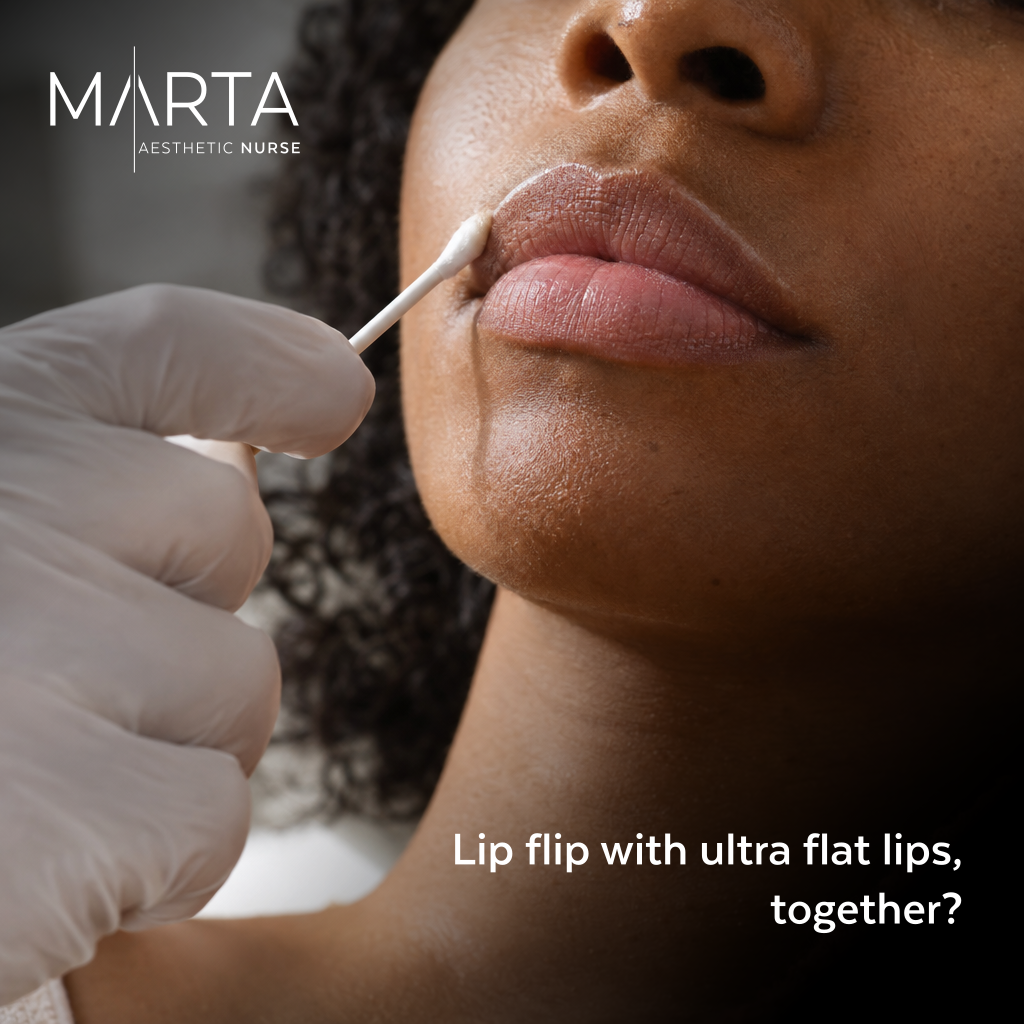
How Structure and Movement Planning Can Fit
Yes, a lip flip and ultra flat lips can be combined when your goal includes two different things at once: a flatter side profile, more upper lip show on smile, and less inward roll.
The key is understanding what you are trying to change. Ultra flat lips is a structural, filler-based approach that focuses on controlled shape and distribution. A lip flip is a toxin-based approach that targets muscle pull around the mouth.
This is one of the most common planning questions clients across Toronto and Vaughan bring to a consultation, because lips are dynamic, and a result that looks refined in photos still has to function well when you speak, drink, and smile.
ChecklistCombine or stage, a consult checklist
Clarify your goal
- Flatter side profile, less forward projection
- More upper lip show on smile
- Less inward roll from muscle pull
Ask about planning
- What is structure (filler) vs movement (toxin) in my case?
- Combine in one plan, or stage to assess movement first?
- What is the follow up and adverse event protocol for perioral work?
Know the regulatory frame
- Dermal fillers are medical devices in Canada, follow the IFU
- A lip flip is off label under the BOTOX COSMETIC monograph wording
Your Goal Usually Has Two Drivers
“Flatter” lips are often described as less forward projection from the side, with less of an outward “bulb,” while still keeping, or subtly increasing, visible vermilion (lip show), especially when you smile. That combination goal matters because profile shape is largely a placement and distribution question, while smile show is often a movement question.
What Flatter Profile Tends to Mean
A flatter side profile usually means controlling anterior projection on lateral view and reducing the appearance of a forward push, while keeping the lips balanced in the full face. In practice, “flat” is rarely a “no filler” request, it is primarily about how volume is distributed.
If you are exploring this style of result, start by reading how Aesthetic Nurse Marta approaches ultra flat lips, because the concept is technique based rather than a regulated product category.
What More Upper Lip Show Can Involve
Upper lip show on smile can be influenced by soft tissue volume and eversion, which is a structure and support question, and by reducing downward or inward pull through upper lip muscle balance, which is a muscle modulation question. People often feel this most when they smile: the lip looks like it tucks under, or disappears, even if the resting shape looks fine.
What Less Inward Roll Often Describes
“Inward roll” is often used to describe lip inversion, meaning the lip curls inward. This can be influenced by orbicularis oris dynamics and by how volume sits in and around the wet dry border, especially in a high movement area.
Ultra Flat Lips and a Lip Flip Target Different Levers
You make better decisions when you separate static shape from dynamic movement. Ultra flat lips is about controlled shape and distribution. A lip flip is about how the upper lip moves on smile.
Filler Based Structure Stays Inside the Product’s IFU
In Canada, Health Canada regulates dermal fillers as medical devices and emphasizes following the product Instruction for Use (IFU), with close attention to warnings and contraindications.
As one example of an IFU that explicitly includes lips, the RESTYLANE® KYSSE™ INSTRUCTIONS FOR USE states: “Restylane Kysse is intended for injection into the submucosal layer to restore or augment the volume of the lips.” The same IFU also states: “Patients should receive prompt medical attention and possibly evaluation by an appropriate health care practitioner specialist should an intravascular injection occur.”
This is the practical translation for you: a “flat” outcome relies on distribution and restraint in forward projection, with selective support where it improves lip show without pushing the profile forward.
A Lip Flip Is Toxin Based, and in Canada It Is Off Label
A lip flip generally refers to perioral injection to alter upper lip roll on smile by modulating muscle pull. Under the Canadian Health Canada product monograph wording for BOTOX COSMETIC® (onabotulinumtoxinA for injection), the authorized indications listed are:
“BOTOX COSMETIC® (onabotulinumtoxinA for injection) is indicated:
Upper Facial Lines
• for the treatment of upper facial rhytides, including forehead, lateral canthus, and glabellar lines.
Lower Facial Muscle Prominence
• for the improvement in the appearance of platysma prominence in adults.”
Because the monograph does not state a lip indication, a lip flip falls outside those authorized indications, and is considered off label in Canada relative to the monograph wording. Off label does not mean casual. It means your injector should treat it as a planned, consented decision with clear functional goals.
Non Obvious Trade Off: Lips Are High Movement, and That Changes Planning
The perioral region moves constantly, and that affects both product behavior and how subtle asymmetries show up. The Canadian Society of Aesthetic Specialty Nurses (CSASN) practice guidance states: “The areas of caution for increased adverse events are the periorbital and the perioral regions.” It adds: “Perioral region presents another challenging area and nodules are known to occur due to issues of proximity to the oral flora/bacteria and mucosa thinness as well as increased muscle movement resulting in movement and compression of the product…”
For a client seeking a flatter profile, this matters because a technically “small” change can still look prominent when it sits in a high movement zone, or when muscle pull repeatedly compresses or shifts product over time.
When Combining Makes Sense, and When Staging Is Cleaner
Combination treatment can be thoughtfully planned, and there is published research evaluating a hyaluronic acid dermal filler and onabotulinumtoxinA used alone and in combination for the perioral area and lower face. Planning still needs to match your anatomy, movement, and tolerance for functional change.
What Research Supports About Combination Planning
A multicenter, randomized, parallel group study first published 06 December 2010 (Dermatologic Surgery) evaluated onabotulinumtoxinA and a hyaluronic acid dermal filler (a 24 mg/mL smooth, cohesive gel) “alone and in combination” for “rejuvenation of the perioral area and lower face.” Ninety female participants aged 35 to 55 were randomized to one of three groups (n equals 30 per group).
In the abstract, the authors report: “For all end points and most time points, subjects treated with onabotulinumtoxinA plus the 24-mg/mL cohesive gel had greater improvement from baseline than subjects treated with onabotulinumtoxinA or the 24-mg/mL cohesive gel filler alone.” The abstract conclusion states: “Combination therapy is superior to either modality used alone.”
This supports the idea that combination approaches can be studied and planned. It does not set modern dosing or sequencing for a lip flip specifically, and it does not change the off label status of perioral toxin under the Canadian monograph wording.
Situations Where Combining Is Often the Logical Plan
Combining can fit when your desired endpoint includes both shape and structure control (a flatter profile with deliberate distribution) and a dynamic change (less inward roll on smile). The decision should be built around a defined plan, rather than adding toxin as an improvised extra.
Because the perioral area is higher caution for adverse events, the clinic’s systems matter. CSASN states each clinic should have “a protocol in place for managing adverse events,” and that adverse events should be reported, including to the manufacturer within 24 hours, and to Health Canada if needed.
Situations Where Staging Can Be the Safer, Clearer Choice
Staging, meaning separating visits, can be useful when you need to “read” baseline movement first. It gives you and your injector time to assess how much of your concern is dynamic pull versus static volume and shape.
Staging also helps in a region CSASN describes as challenging, with nodule risk factors that include thin mucosa, proximity to oral flora or bacteria, and frequent muscle movement that can move or compress product. If there is swelling or asymmetry, staging makes troubleshooting simpler because fewer variables changed at once.
If any off label perioral toxin is being considered, staging can also help manage functional risk. The BOTOX COSMETIC® product monograph includes a “SERIOUS WARNINGS AND PRECAUTIONS BOX” that states: “DISTANT SPREAD OF TOXIN EFFECT: The effects of Botox Cosmetic and all botulinum toxin products may spread from the area of injection to produce symptoms consistent with botulinum toxin effects… Swallowing and breathing difficulties can be life-threatening and there have been reports of death…”
What to Expect as It Settles
Set expectations around the two different mechanisms, filler structure and toxin driven muscle modulation. They do not “settle” in the same way, and your follow up plan should reflect that.
Anti Wrinkle Injections: Duration and Safety Signals
On Health Canada’s Cosmetic injections page, the effects of Botox® Cosmetic treatments “generally last anywhere from three to four months.” The same page also states: “Botox® Cosmetic injections should only be given by a qualified health care provider, no more frequently than every two months (according to the Canadian product monograph (CPM)).”
Health Canada also lists symptoms that can signal toxin spread, including swallowing, speech, or breathing problems, as reasons to seek urgent care.
Hyaluronic Acid Filler: Intended Use and Serious Risk Framing
For lip filler, stay anchored to the specific device’s IFU for intended use. In the RESTYLANE® KYSSE™ INSTRUCTIONS FOR USE example, the intended plane is specified as the submucosal layer for restoring or augmenting lip volume. The IFU also carries explicit vascular risk framing and states that prompt medical attention is needed if an intravascular injection occurs.
If you want broader preparation and aftercare guidance, review the clinic’s patient information and care page before scheduling, because it helps you plan around swelling, bruising, and when to postpone a treatment.
Safety and Candidacy Points That Affect the Plan
Lips and the perioral area deserve careful screening. The most important safety step is an anatomy first assessment that matches product choice to intended use, and matches your movement patterns to the plan.
When Health Canada Advises Avoiding or Postponing Filler
On its Cosmetic injections page, Health Canada advises avoiding or postponing dermal filler treatment if a patient has, among others: “a history of severe allergies…”, “an allergy to collagen, eggs, or lidocaine”, “inflamed or infected skin”, “a bleeding disorder”, or a “tendency to excessive scarring, such as keloids.” Health Canada also notes: “Some injectable products are not recommended for lips.”
Botulinum Toxin Contraindications and the Class Warning
The BOTOX COSMETIC® product monograph states: “Botox Cosmetic is contraindicated in:
• patients who are hypersensitive to any botulinum toxin type A or to any ingredient in the formulation or component of the container…
• the presence of infection at the proposed injection site(s).”
It also contains the boxed warning on distant spread of toxin effect. This is part of informed consent, especially when discussing any use close to the mouth where small functional changes matter.
A Practical Question to Bring to Your Consult
Ask your injector how they plan to separate your static goal (profile and shape) from your dynamic goal (what happens when you smile), and what their follow up and adverse event protocol looks like for the perioral region. If you are choosing a provider in the GTA, you can also review the clinic’s Vaughan information page for logistics and access: aesthetic treatments in Vaughan.
Combining a lip flip with ultra flat lips can be a good fit when you want a flatter side profile and a movement based change in how the upper lip rolls on smile, and when both steps are planned as one concept. Staging can be the cleaner option when you want to assess movement first, or when you prefer changing fewer variables at a time in a high movement area.
If you want a personalized plan built around your lip shape and smile dynamics, the next step is to request an assessment and talk through sequencing: book now.
Questions Clients Often Ask
Can you do a lip flip and filler together?
It can be planned together when you want both structural shape control and a change in smile dynamics, rather than treating toxin as an add on.
What is the difference between a lip flip vs filler?
Filler is used for controlled shape and support, while a lip flip targets muscle pull that can affect how the upper lip rolls on smile.
Is a lip flip an authorized use of BOTOX COSMETIC in Canada?
The Health Canada product monograph lists indications for upper facial rhytides and platysma prominence, so a lip flip falls outside that wording and is off label.
How long do Botox Cosmetic effects last?
Health Canada states the effects of Botox Cosmetic treatments generally last anywhere from three to four months.
What makes the perioral area higher risk for nodules?
CSASN notes the perioral region as a challenging area, citing proximity to oral flora or bacteria, thin mucosa, and frequent muscle movement that can move or compress product.

Marta Morozova, RNFounder of Aesthetic Nurse Marta, Vaughan
Request a personalized assessment: Contact Aesthetic Nurse Marta
7777 Weston Rd, Unit 102, Vaughan, ONFor clients in Vaughan, Woodbridge, Toronto and Richmond Hill
Every treatment starts with an in-person assessment, and results differ from person to person. This article is general information, not medical advice.
Sources
- PRODUCT MONOGRAPH: Botox Cosmetic (onabotulinumtoxinA)
- Cosmetic injections (Health Canada)
- Multicenter, Randomized, Parallel-Group Study of the Safety and Effectiveness of OnabotulinumtoxinA and Hyaluronic Acid Dermal Fillers (24-mg/mL Smooth, Cohesive Gel) Alone and in Combination for Lower Facial Rejuvenation (Dermatologic Surgery; first published 06 December 2010)
- RESTYLANE® KYSSE™ INSTRUCTIONS FOR USE (Galderma; IFU)
- Canadian Guidelines and Practice Standards for Nurses Practicing in Medical Aesthetics (CSASN)


