A Better Way to Talk About Lip Goals
If you have ever compared your lips in a front facing selfie and then felt unsure what really changed, you are already running into the reason lip fullness scales exist. A lip fullness scale is a standardized grading system that turns a subjective impression of fullness into a repeatable score assigned from reference photos and defined descriptors.
This matters for clients across Toronto and Vaughan because lips are one of the easiest areas to misjudge on camera. Clinical photography and grading aim to reduce that distortion so you and your injector can talk about change in a clearer, calmer way.
A 2026 open access validation study in the Journal of Cosmetic Dermatology describes a 5 point photonumeric tool called the Humedix Lip Fullness Scale and reports very high agreement when expert raters graded the same images. That same mindset can make your consultation photos and your goal setting much more useful.
What a Lip Fullness Scale Measures
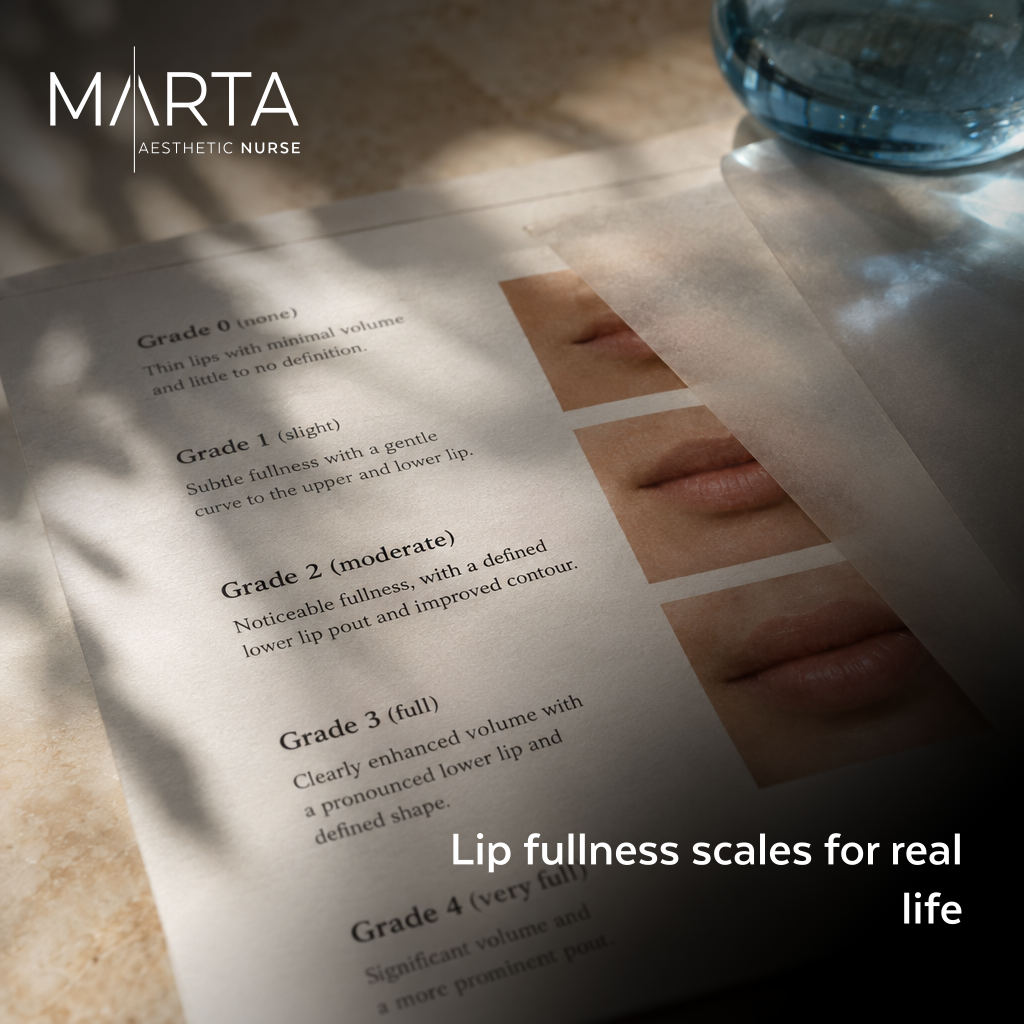
A lip fullness scale is a way of scoring lip fullness by matching your lips to standardized reference photos and written definitions. The 2026 Journal of Cosmetic Dermatology validation paper describes the Humedix Lip Fullness Scale as a 5 point photonumeric grading system, from Grade 0 through Grade 4, with defined descriptors for each grade.
The point is repeatability. Instead of relying on memory or a single flattering angle, a scale gives you a shared language for the visible features that create the impression of fullness.
The Grade Descriptions, in Plain Words
The Humedix Lip Fullness Scale definitions are written in everyday visual cues, which makes them surprisingly helpful in a consultation. In the paper, the grades are described as follows:
- Grade 0 (minimal): flat or nearly flat contour with minimal visible red lip
- Grade 1 (mild): some red lip visible; no lower lip pout
- Grade 2 (moderate): moderate red lip visible with slight lower lip pout
- Grade 3 (marked): significant red lip visible with lower lip pout and moderate upper lip protrusion
- Grade 4 (very marked): very significant red lip visible with pronounced lower lip pout and overall lip protrusion
If you are bringing inspiration photos, notice how these definitions separate different “dials” of fullness. Visible red lip, lower lip pout, and upper lip protrusion can read very differently from one face to another.
ChecklistLip consult photos that measure real change
Angles to bring
- Front view
- Left lateral view
- Right lateral view
Consistency rules
- Neutral expression, lips relaxed
- Same lighting setup each time
- Same camera position and distance
Why Studies Use Scales, and Why You Should Care
In research, a scale is used so outcomes can be compared across time and across evaluators using the same measurement language. In real life, the same idea protects you from chasing a moving target created by changing angles, lighting, and camera distance.
Reliability Was the Whole Point of the 2026 Validation Study
The 2026 Journal of Cosmetic Dermatology paper was a scale development and validation study, not a treatment trial. It tested whether different expert raters would grade the same lips similarly (inter rater reliability) and whether the same rater would grade the same photos the same way at different times (intra rater reliability).
It reports very high agreement. All five raters achieved perfect intra rater reliability (weighted Cohen’s kappa = 1.0000). For inter rater agreement, Fleiss’ Kappa coefficient was 0.96821 (95% CI: 0.93771–0.99870). In other words, when the photos and the rules are standardized, trained people can agree on what they are seeing.
A Non-Obvious Detail: Generalizability Depends on Who the Scale Was Built On
The same study also highlights a limit that matters in a multicultural city. It states the dataset was Asian majority (96.2%), and it notes that exclusive use of female subjects may limit generalizability. The authors call for validation in male and multiethnic cohorts.
For you, this has a practical implication. A “validated” scale can still reflect the population it was developed on, which makes your own baseline photos and your own features the most meaningful reference. Your goal becomes a measured change on your face, rather than matching a viral template from someone with different anatomy.
How to Take Consult Photos That Actually Help
The validation study standardized its photography tightly, because scale scoring only works when images are consistent. You can use the same logic when you bring photos to a lip consultation or when you track your own progress over time, including for an Ultra Flat Lips consultation.
Use Three Angles, and Keep Them Consistent
The study photographed participants from three angles: front, left lateral, and right lateral. Those angles line up with what the scale grades.
- Front: helps you see overall visible red lip and symmetry.
- Left and right lateral: help you see projection and pout, including features named directly in the scale definitions such as lower lip pout and upper lip protrusion.
Bringing both side views matters because a single “best side” photo can hide asymmetry and set you up for a goal that only exists in one pose.
Lighting Changes the Look of Fullness
The study controlled lighting by using consistent lighting, a single photographer, and a standardized camera setup. That is a reminder that lighting can change what you think you are seeing.
Shadows can make the lip border look deeper and more defined, which can read as more projection. Bright frontal light can flatten texture and blur edges, which can expand the highlight across the red lip and make lips appear larger in photos than they do in person. Bottom up lighting, common in selfies, can exaggerate lower lip prominence, the same feature the scale calls “lower lip pout.”
Camera Distance Can Create False Change
In the study, the camera was placed on a tripod with standardized settings to avoid handheld variation. The practical takeaway is simple: close up selfies often change proportions because features closest to the lens look larger.
For lips, that can make the mouth look disproportionately prominent compared with the nose or chin. If you use that photo as your target, you can end up requesting a look that only makes sense at that very short camera to face distance.
A Simple Photo Protocol You Can Follow
You do not need studio equipment to improve your documentation. You need repeatability. Here is a client friendly protocol aligned with the study’s approach:
- Take three views each time: front, left lateral, right lateral.
- Use a neutral expression with lips relaxed, since pursing increases pout and protrusion, which are exactly what the scale grades.
- Choose one lighting setup and reuse it each time.
- Keep the camera position and distance the same, rather than switching between arm’s length selfies and zoomed photos.
How to Describe Your Goal Without Chasing a Template
A useful consultation goal is specific, measurable, and connected to your own baseline. Lip fullness scales help because they describe fullness as an ordinal change, rather than a single ideal shape.
Borrow Change Language From the Scale
Because the Humedix Lip Fullness Scale is an ordinal 0 to 4 scale, it naturally supports goal statements focused on degree of change. You can discuss what you want to increase, based on the features in the definitions: more visible red lip, more lower lip pout, or more upper lip protrusion.
This approach also makes it easier to review your results later using consistent photos, since you are assessing the same cues across time.
Keep Safety and Labeling in the Conversation
In Canada, injectables are medical products and procedures. Health Canada’s guidance on cosmetic injections emphasizes following the Instruction for Use (IFU) or the Canadian Product Monograph (CPM) of any product, with close attention to warnings and contraindications. It also notes that some injectable products are not recommended for lips.
Health Canada also advises avoiding or postponing dermal filler treatment in specific situations, including inflamed or infected skin, a bleeding disorder, a history of severe allergies marked by anaphylactic shock, and a tendency to excessive scarring such as keloids. A clear assessment and clear documentation support safer decision making because they reduce the urge to “correct” a camera artifact with more treatment.
What a Careful Lip Assessment Looks Like in Ontario
In Ontario, aesthetic services are professional services with standards around how they are provided. The College of Nurses of Ontario (CNO) describes aesthetic services as procedures, often controlled acts, done for the purpose of cosmetic treatment to enhance, preserve or alter a client’s appearance, and it explicitly lists dermal fillers as an example involving controlled acts.
CNO also notes standards changes coming into effect on March 1, 2027. For aesthetic services involving prescription drugs or controlled acts, nurses will be expected to use client specific orders instead of directives. CNO’s “Medication” practice standard states that, when providing aesthetic services that involve prescription drugs or treatments involving controlled acts (for example, injections of any substance, whether a prescription drug or otherwise), CNO requires that NPs issue only client specific orders, and nurses accept only client specific orders from authorized prescribers.
For you, this translates into a consultation that is individualized, documented, and based on your features and your health history, rather than a one size target photo.
Questions to Bring to Your Consultation
If your priority is natural looking lip enhancement, the most useful questions are the ones that clarify how your change will be assessed and recorded. A good conversation stays grounded in consistent photos, clear goals, and product labeling.
- “Can we review my front and side photos together, so I understand what looks full from each angle?”
- “Which of the scale cues are we aiming to change: more visible red lip, more lower lip pout, or more upper lip protrusion?”
- “How will we keep my documentation consistent, so we are judging the same angles and lighting each time?”
- “Which situations mean I should avoid or postpone treatment, based on Health Canada’s cosmetic injections guidance?”
- “Who will be performing the treatment, and how is the plan ordered and documented?”
If you are thinking about lip filler, a lip fullness scale is a reminder that good results are assessed with consistency, not with a single selfie. Bring three angles, keep the conditions similar, and talk in specific cues, visible red lip, lower lip pout, upper lip protrusion, rather than chasing a template.
For preparation and aftercare basics, start with Patient information and care, then plan your consultation around your own baseline photos and your own goals.
Questions Clients Often Ask
What is a lip fullness scale?
It is a standardized photonumeric grading system where trained evaluators assign an ordinal score to lip fullness using reference photos and defined descriptors.
What photo angles help most for tracking lip change?
The 2026 validation study used three angles: front, left lateral, and right lateral, which help assess visible red lip and features like pout and protrusion.
Why can selfies make lips look different than they do in person?
Changes in lighting and close camera distance can distort proportions and shadows, creating “false change” that is not consistent across photos.
How can I describe a natural looking lip goal more clearly?
Use the scale cues as your language: whether you want more visible red lip, more lower lip pout, or more upper lip protrusion, measured against your baseline.
What does Health Canada emphasize for cosmetic injections?
Health Canada advises following the Instruction for Use or Canadian Product Monograph and paying close attention to warnings and contraindications, and notes some injectable products are not recommended for lips.

Marta Morozova, RNFounder of Aesthetic Nurse Marta, Vaughan
Book a consultation with Aesthetic Nurse Marta
7777 Weston Rd, Unit 102, Vaughan, ONFor clients in Vaughan, Woodbridge, Toronto and Richmond Hill
Every treatment starts with an in-person assessment, and results differ from person to person. This article is general information, not medical advice.