
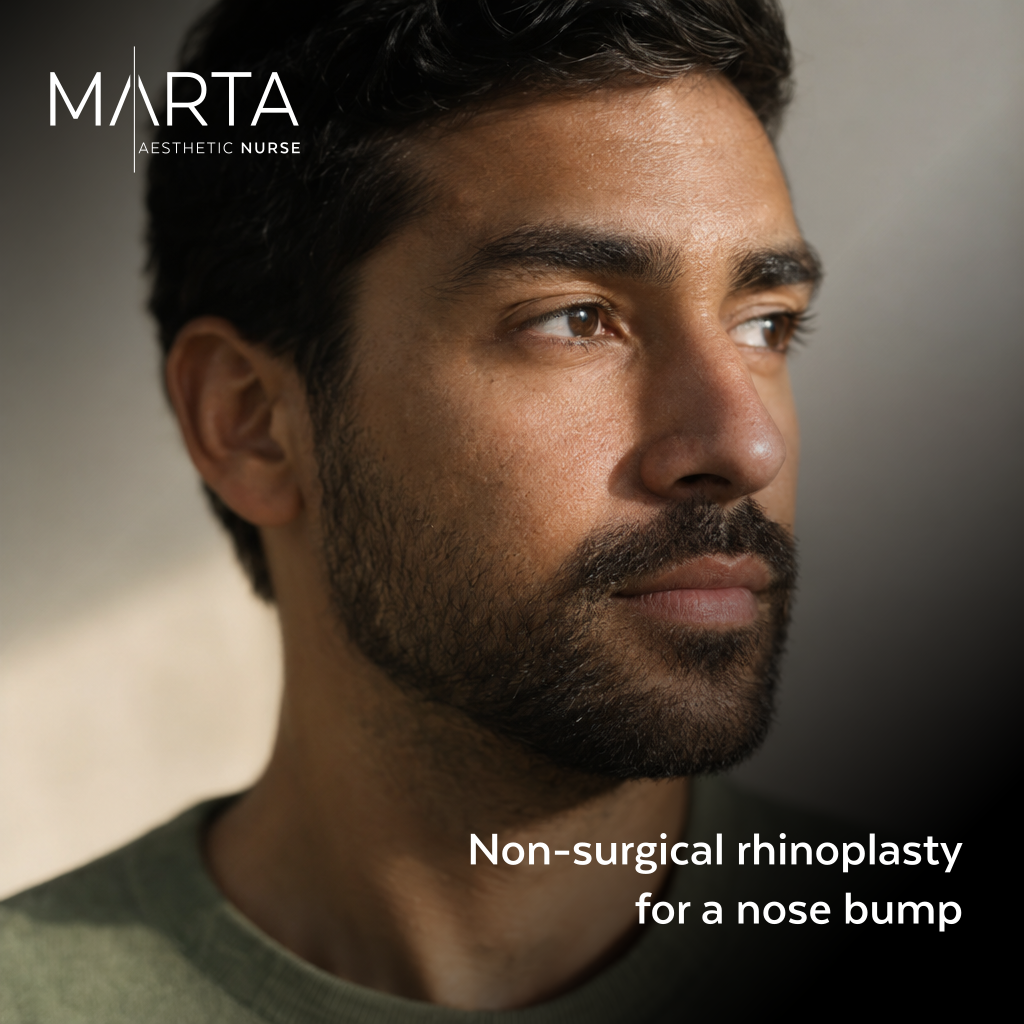
How Camouflage Can Smooth a Profile Line
If your side profile is what keeps catching your eye, it is often because the dorsal line (the bridge line from the upper nose to the tip) has a break in it. A small bump, a dip, or mild asymmetry can read as “crooked” in certain lighting or photos, even when the nose is healthy and functions well.
Non-surgical rhinoplasty (often called liquid rhinoplasty) is an injectable approach that aims to change the look of that line through careful placement of dermal filler. In a 2023 review in the World Journal of Otorhinolaryngology – Head and Neck Surgery, Hall and Kontis describe non-surgical rhinoplasty as “the use of injectable filler in the nose to achieve aesthetic and, in some cases, functional results,” used in both “primary and revision rhinoplasty cases.”
This is a question clients across Toronto and Vaughan ask before booking: can filler change the look of a bump without making the nose look heavier. The answer depends on the camouflage principle, and on selection, because filler adds volume by design.
What Bump Correction Changes
A nose bump is usually noticed as a disruption in the bridge line rather than as a single isolated point. Non-surgical rhinoplasty can be used for specific dorsal and symmetry type concerns described in the Hall and Kontis review, including “augmentation of the radix,” “dorsal hump correction,” and “Correction of nasal sidewall deformities and asymmetries.”
Camouflage, Not Reduction
The key shift to understand is that dermal filler does not remove tissue. The visual goal is to change how the dorsal aesthetic line reads by adding controlled support near the irregularity.
In the same 2023 review, the authors describe the concept directly in a figure caption: “The nasal dorsum is straightened by injection of filler above and below the dorsal nasal hump.” For a suitable candidate, that “above and below” placement can make a profile look straighter because the eye follows a smoother line.
Why Some Noses Look Bigger Instead
Camouflage always involves adding volume. Hall and Kontis state: “Patients requiring reduction rhinoplasty are generally not good candidates, as placement of filler in the skin-soft tissue envelope invariably adds volume to the nose.”
This is the trade off many people miss when they are focused on a single bump in the mirror. If your real goal is a smaller nose, non-surgical rhinoplasty may not match that goal, because the mechanism is additive.
ChecklistQuestions to ask before non-surgical rhinoplasty
Goal and expectations
- Is my goal camouflage of a dorsal line break, or true reduction?
- Do I understand results are temporary in most cases?
Candidacy and tissue
- Do I have enough skin laxity for safe filler placement?
- Does prior rhinoplasty make this a higher risk choice for me?
Consent and safety
- Will off-label nose use be discussed clearly in my consent?
- What urgent symptoms should prompt immediate medical attention?
Who Tends to Suit This Approach
Good outcomes start with matching the method to your anatomy and your expectations. The Hall and Kontis review is clear that patient selection matters and that the result is, for most people, temporary.
Expectations and Temporary Results
According to Hall and Kontis, the patient most well suited for non-surgical rhinoplasty is “in good overall health with reasonable postprocedure expectations.” They add that this includes “an explicit understanding that, in most cases, results obtained with NSR are temporary.”
In a consult, that expectation check matters as much as the profile analysis, because a subtle camouflage plan and a dramatically different “new nose” request are two different conversations.
Skin and Tissue Factors That Matter
Technique and anatomy are closely linked in the nose. Hall and Kontis write: “Inspection and palpation of the skin of the nose is paramount, as adequate skin laxity is required to accommodate the placement of filler material in the correct plane.”
They also flag a higher risk situation: “Extensive skin tightness of the nasal soft-tissue envelope, often seen in postrhinoplasty patients, can lead to increased risk of improper filler placement and complications associated with vascular compression. NSR is therefore best avoided in these patients.”
If you have had previous nasal surgery, the decision becomes more nuanced, because the soft tissue envelope can behave differently, and the risk discussion changes.
What the Appointment Can Involve
Non-surgical rhinoplasty is an injector dependent procedure. Many clients focus on the idea of “filler for a nose bump,” but the day of treatment is really about precision, restraint, and a plan that prioritizes facial harmony rather than a single feature.
At Aesthetic Nurse Marta, this type of discussion fits naturally into an anatomy first consultation style and, when appropriate, a broader facial harmonization assessment, because your nose does not sit in isolation from the chin, lips, and midface.
Topical Anesthetic Timing
Hall and Kontis describe that “a topical anesthetic such as benzocaine/lidocaine/tetracaine cream can be applied 15-30 min before injection.”
Technique Themes From the Literature
Individual technique choices belong to your injector, but the review does describe several themes that align with a subtle outcome.
- “A 30-gauge needle is used to deposit small boluses (<0.1 ml) of filler ”
- “The injection should be placed in the midline ”
- “Undercorrection should be the goal ”
If you are seeking refined change, that last point matters. “Undercorrection” signals an intent to stay conservative, then reassess, rather than chasing an immediately dramatic profile.
Off-Label Use in the Nose, and Why Consent Matters
Many people assume that “nose filler” is a standard labelled indication. The medical literature does not frame it that way.
How the 2023 Review Describes It
Hall and Kontis state: “Use of any dermal filler in the nose is off-label and patients should be advised accordingly.” In practice, that should translate into clear consent language and a discussion of what is being attempted, and what is not.
For patient safety, Health Canada’s dermal filler guidance also emphasizes that labelling should specify the “specific site of injection as well as depth of injection.” This matters because, in Canada, nasal use may fall outside many fillers’ Instructions for Use unless a specific device label explicitly includes the nose.
Safety: What a Careful Injector Plans For
Non-surgical rhinoplasty sits in a part of the face where anatomy knowledge and clinical judgment carry real weight. Safety in this context means a thorough risk discussion, plus a clear plan for what to do if something feels wrong after you leave the clinic.
If you are considering non-surgical rhinoplasty with filler, it is reasonable to ask who will be injecting, what training and experience they have, and how follow up is handled.
Health Canada’s Warning on Vascular Compromise
In “Health Product InfoWatch – August 2016,” Health Canada explains that “Inadvertent vascular injection may lead to embolization and in rare cases may result in permanent vision impairment, blindness, stroke, and necrosis of the underlying facial tissue.”
In the same item, Health Canada reports: “As of June 2016, Health Canada has received a total of 16 adverse incident reports describing facial vascular compromise with dermal filler injections.” Of these 16 reports, “Six described ocular complication including 4 reports of vision disorders/partial vision loss and 2 of blindness,” “6 reports described necrosis,” and other outcomes were also listed in the bulletin.
Symptoms That Need Urgent Attention
Health Canada notes that symptoms in these reports “presented immediately or within a few hours of injection; some were reported after 2, 5, or 7 days.”
Health Canada advises seeking immediate medical attention if you experience “unusual pain,” “vision changes,” “blanching of the skin,” or neurological changes associated with a stroke (during or after a procedure), including sudden difficulty speaking, numbness or weakness in face, arms, or legs, difficulty walking, face drooping, or severe headache, dizziness, or confusion.
Why Anatomy First Is More Than a Slogan
Health Canada also reminds clinicians of “the importance of having adequate training, experience and knowledge to prevent adverse incidents from inadvertent vascular injection such as arteriole embolus, blindness and necrosis.”
For you as a client, the practical takeaway is to choose an injector who can explain the plan clearly, discuss off label use directly, and guide you through preparation and aftercare in a way that supports informed consent. Our general clinic guidance for planning and aftercare is kept in Patient information and care, which you can review before a consult.
If your concern is a bridge bump or mild asymmetry, non-surgical rhinoplasty can be about one thing: changing how the dorsal line is read by adding controlled support around the irregularity. The right candidate understands that the approach is additive, and that the aim is refined balance, not reduction.
Questions Clients Often Ask
Can filler actually remove a nose bump?
Non-surgical rhinoplasty changes how a bump reads by camouflage. A 2023 review describes straightening the dorsum by adding filler above and below the hump.
Is non-surgical rhinoplasty considered off-label?
Yes. Hall and Kontis state that use of any dermal filler in the nose is off-label and patients should be advised accordingly.
Who is usually a poor candidate for liquid rhinoplasty?
People seeking reduction are generally not good candidates, since filler “invariably adds volume to the nose,” according to Hall and Kontis.
Why does skin tightness matter for nose filler?
Hall and Kontis write that adequate skin laxity is needed for filler placement, and they say NSR is best avoided with extensive skin tightness seen in some postrhinoplasty patients.
What symptoms after filler need urgent attention?
Health Canada lists unusual pain, vision changes, blanching of the skin, and stroke-like symptoms such as face drooping or sudden difficulty speaking as reasons to seek immediate medical attention.
If you want an anatomy first assessment in Vaughan, request a consult with Aesthetic Nurse Marta at 7777 Weston Road, Unit 102: consultation request for non-surgical rhinoplasty.
To arrange an anatomy-first assessment, contact Aesthetic Nurse Marta directly: Request a consultation with Aesthetic Nurse Marta.
Sources
- Nonsurgical rhinoplasty – PubMed record (PMID: 37780677)
- Health Product InfoWatch – August 2016 (includes “Adverse incidents with injectable dermal fillers – facial vascular compromise: Update”)
- Nonsurgical rhinoplasty – World Journal of Otorhinolaryngology – Head and Neck Surgery (Hall SS, Kontis TC). First published: 02 July 2023