
A Facial Harmonization Way to Assess
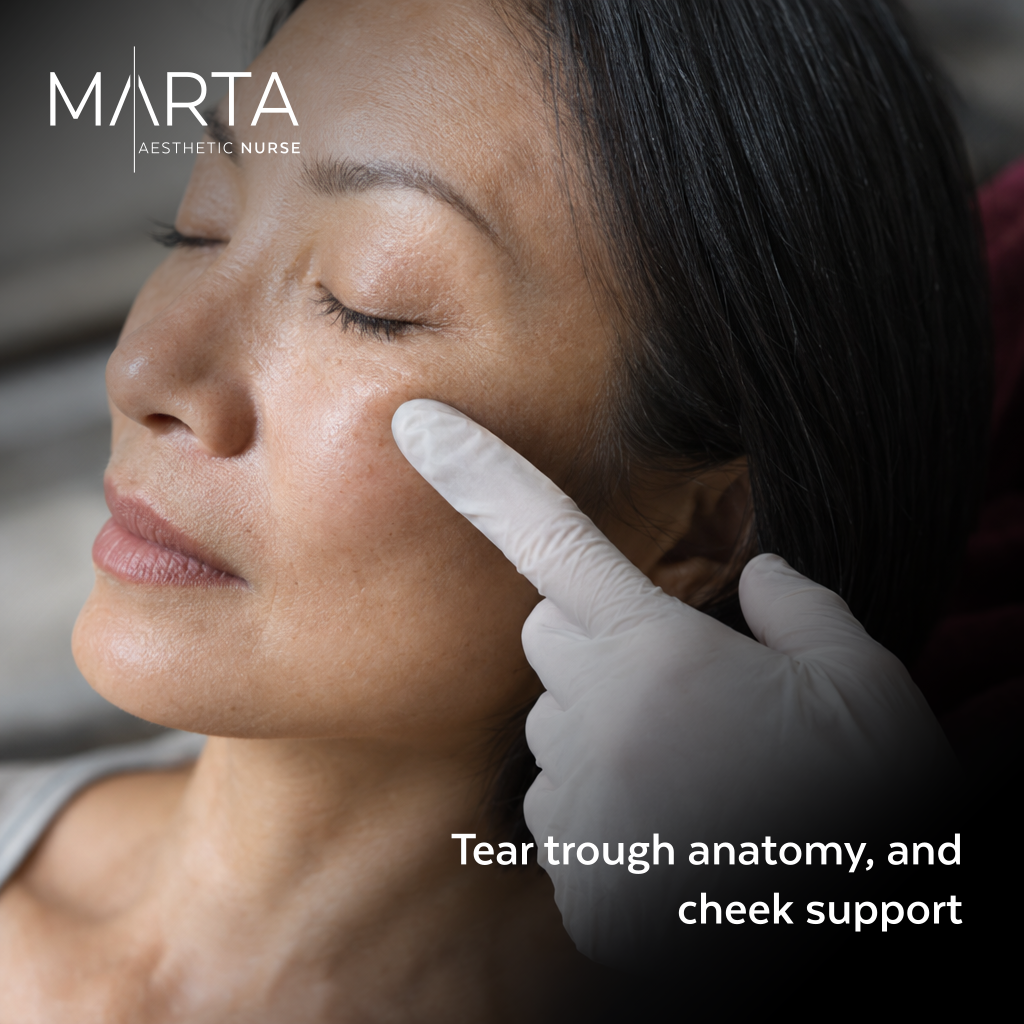
If you are focused on the under eye line, it can feel logical to treat the under eye line. Tear trough anatomy explains why careful injectors step back and assess the full lid cheek junction, including cheek support, before planning any correction.
This comes up often for clients across Toronto and Vaughan who want a rested, refined under eye, without creating puffiness or an overfilled look. The anatomy in this area is layered, tethered, and closely connected to how the midface supports the transition.
On May 18, 2026, Aesthetic Surgery Journal published a review titled “Tear Trough Deformity: Update on Anatomy and Clinical Management.” The publication record is accessible on PubMed, and it reinforces why anatomy based assessment remains central to planning under eye care.
Why the Under Eye Reads as a Shadow
The tear trough area is part of a visible transition between the eyelid and the cheek. That transition can catch light and create shadow because the tissues change quickly from one side to the other.
An anatomic cadaver study describing the tear trough and lid cheek junction found that, in the subcutaneous plane, the tear trough and lid cheek groove overlie the junction of the palpebral and orbital portions of the orbicularis oculi muscle and the cephalic border of the malar fat pad.
A related Plastic and Reconstructive Surgery PDF describes why this junction can look sharp: thin eyelid skin with minimal or no subcutaneous fat over palpebral orbicularis transitions into thicker cheek skin with subcutaneous fat. When that contour breaks, the eye can look darker or more tired because light falls differently across the area.
ChecklistTear trough consult checklist
Anatomy and plan
- Ask how your lid cheek junction is being assessed
- Ask how cheek support affects your under-eye shadowing
- Ask what “conservative staging” means for you
Safety and follow up
- Ask how vascular risks are discussed in consent
- Ask what symptoms mean injection should stop immediately
What Cheek Support Really Means Here
Cheek support matters because the under eye transition is built on surrounding structures, not just the groove itself. If you only focus on the visible line, you can miss the support that shapes the contour from below and beside.
The Malar Fat Pad Border Is Part of the Junction
In the same anatomic description, the cephalic border of the malar fat pad is named as part of what the tear trough overlies. In practical terms, the cheek and midface can influence the continuity of the lid cheek contour, which can change how much shadow you see under the eye.
Tethering Differs Across the Region
Deep to orbicularis, the tear trough region and the lateral lid cheek junction behave differently. Along the tear trough, the orbicularis muscle is described as attached directly to bone. Along the lid cheek junction, the attachment is ligamentous by means of the orbicularis retaining ligament.
This kind of tethering helps explain why under eye concerns can look “stuck” in some subregions and softer in others. It also supports a facial harmonization approach that looks at the whole transition, not only the crease.
A Non Obvious Planning Point: Planes Are Not Uniform
One detail that tends to change how you think about under eye planning is that the available planes differ by subregion. The Plastic and Reconstructive Surgery PDF states: “Unlike the tear trough region, there is a plane deep to the [orbicularis] muscle into which material can be injected or surgical dissection performed.”
For a client, this matters because it explains why the under eye is rarely a single step decision. The anatomy can dictate where a correction can be approached, and where it may carry different risk trade offs.
Why Conservative Staging Fits Refined Results
Conservative staging means aiming for incremental correction with reassessment, rather than trying to “finish” the under eye in one pass. In a safety focused practice, that conservative pacing aligns with how regulators and Canadian consent literature frame the risks of soft tissue fillers.
Health Canada Expects Clear Vascular Risk Warnings
Health Canada’s guidance on dermal filler premarket applications specifies that labelling and Instructions for Use should include indications, contraindications, warnings and precautions, and adverse events. It also states that warnings applicable to all dermal fillers should include “The risks of potential complications associated with intravascular injection,” and “Avoid injection into blood vessels.” The document lists “Date Adopted: 2016/11/24, Effective Date: 2017/01/16.”
What Canadian Market Filler Labelling Says in Plain Language
Revanesse® Shape™ Instructions for Use includes explicit language on vascular risk: “Introduction of product into the vasculature may lead to embolization, occlusion of the vessels, ischemia, or infarction.” It also states: “Rare but serious adverse events associated with the intravascular injection of soft tissue fillers in the face have been reported and include temporary or permanent vision impairment, blindness, cerebral ischemia or cerebral hemorrhage, leading to stroke, skin necrosis, and damage to underlying facial structures.”
It adds an action point: “Immediately stop the injection if a patient exhibits any of the following symptoms, including changes in vision, signs of stroke, blanching of the skin, or unusual pain during or shortly after the injection.”
For readers, the takeaway is not fear. It is clarity about why a careful injector prioritizes planning, conservative correction, and a follow up strategy.
Consent Language in a Canadian Review
A Canadian review on soft tissue filler therapy and informed consent states: “The major acute complication from STF treatment is vascular occlusion. If the occlusion is not one that is recognized or able to be reversed, the result is permanent tissue loss and scarring.” It also notes that filler can traverse arterial anastomoses, causing obstruction distant from the injection site.
On blindness risk, it states: “When injecting within the distribution of arteries that communicate with the ophthalmic artery, there is a risk of blindness.” It reports: “The incidence of blindness is very rare, with less than five medical-legal cases in Canada in the past 15 years (Table 3).”
How We Apply This in Facial Harmonization
At Aesthetic Nurse Marta, under eye planning sits inside a facial harmonization assessment, because the lid cheek junction is structurally connected to the cheek and midface. A focused under eye plan often begins by mapping what is creating the shadow: skin thickness transitions, muscular junction, ligamentous tethering, and support from the malar fat pad border.
If your concern is “under eye hollow vs cheek,” the most useful consultation question is simple: ask what the assessment shows at the lid cheek junction, and how cheek support is influencing what you see.
Some clients also want an option that sits outside filler planning. In our clinic, Under-Eye Peptide Rejuvenation is one of the ways we discuss under eye appearance within a broader plan, depending on your goals and what an in person assessment finds.
Choosing an Injector in Ontario
Because this region is anatomy dense and risk sensitive, who assesses and treats you matters. A nurse led clinic should be working within Ontario nursing expectations for safe aesthetic services.
The College of Nurses of Ontario describes that its guideline aims to support safe aesthetic services for Ontarians, including clarifying nursing accountabilities, outlining the use of Health Canada approved substances, products and equipment, making sure supports are in place to respond to side effects or medical emergencies, and using ethical advertising by nurses and employers.
In practice, our treatments are performed by Registered Nurses, including Marta Morozova, RN, and Nurse Yasmin. If you are comparing clinics for toronto filler planning around the under eye, consider reading About Marta morozova so you understand who is treating you and how care is governed.
Questions to Bring to Your Consult
A good consult for tear trough anatomy should feel like an assessment, not a script. These questions help you get a plan that matches your structure and risk comfort.
- “Are you assessing my lid cheek junction and cheek support, or focusing on the under eye line alone?”
- “What does my anatomy suggest about where the shadow is coming from?”
- “How do you approach conservative staging, and what would reassessment look like?”
- “What safety planning do you have in place for rare but serious vascular events?”
Tear trough anatomy points to one core idea: the under eye is a transition zone shaped by the cheek, muscle junctions, and ligament support. For many people, the most refined plan starts with full face assessment and conservative staging.
If you want a structured tear trough assessment in the GTA, book a visit through our Aesthetic treatments in Vaughan page, then use Book now to choose a time.
Questions Clients Often Ask
Why does cheek support matter for under-eye shadowing?
The tear trough overlies the orbicularis junction and the cephalic border of the malar fat pad, so midface support can influence the lid cheek contour.
What makes tear trough anatomy complex?
The transition involves skin thickness differences, orbicularis segmentation, ligamentous tethering, and the malar fat pad border.
Why do injectors talk about conservative staging under the eyes?
Health Canada expects dermal filler labelling to warn about intravascular injection risks, and Canadian consent literature highlights vascular occlusion as a major acute complication.
What serious risks are discussed for soft tissue fillers?
Canadian labelling and consent literature describe intravascular injection risks, including vascular occlusion, and rare but serious events such as vision impairment or blindness.
Who performs treatments at Aesthetic Nurse Marta?
Treatments are performed by Registered Nurses, including Marta Morozova, RN, and Nurse Yasmin.

Marta Morozova, RNFounder of Aesthetic Nurse Marta, Vaughan
Contact us to book a tear trough assessment
7777 Weston Rd, Unit 102, Vaughan, ONFor clients in Vaughan, Woodbridge, Toronto and Richmond Hill
Every treatment starts with an in-person assessment, and results differ from person to person. This article is general information, not medical advice.
Sources
- Tear Trough Deformity: Update on Anatomy and Clinical Management (PubMed record)
- Guidance on Preparation of Premarket Medical Device Applications for Dermal Fillers (Health Canada Guidance Document; Date Adopted: 2016/11/24, Effective Date: 2017/01/16)
- Soft Tissue Filler Therapy and Informed Consent: A Canadian Review
- The tear trough and lid/cheek junction: anatomy and implications for surgical correction (PubMed record)
- The Tear Trough and Lid/Cheek Junction: Anatomy and Implications for Surgical Correction (Plastic and Reconstructive Surgery PDF)


