Focused Ultrasound Tightening That Builds Over Months
Marta has added Ultraformer MPT to her clinic in Vaughan. If you have started to notice early laxity along your jawline or neck and you would like a non-surgical way to tighten that still looks like you, this is a treatment worth understanding.
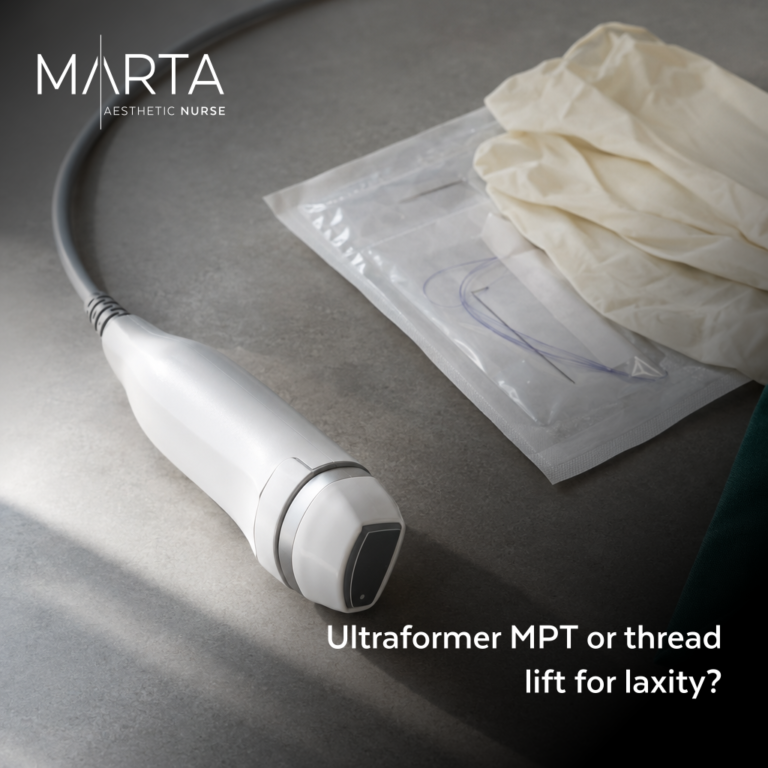
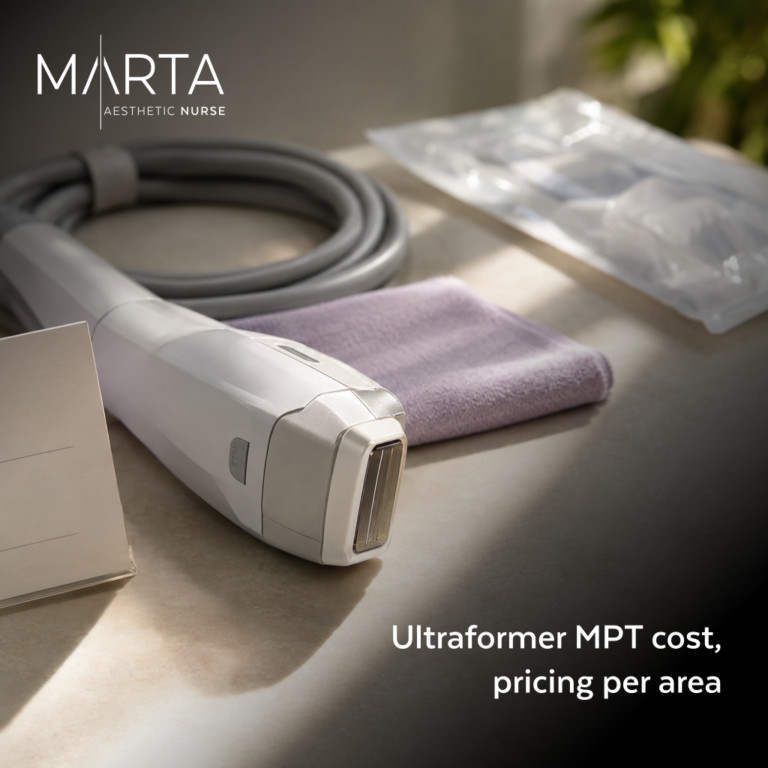
Ultraformer MPT is not an injectable. It is a focused ultrasound device, often called HIFU (high-intensity focused ultrasound), and its change is gradual: it develops in the months after a session. Below are the questions clients ask most, answered plainly.
TimelineHow Ultraformer MPT results tend to unfold
- Same dayRedness, sometimes with swelling, appears in almost all patients
- Up to 1 weekRedness and swelling can last this long
- Up to 3 monthsResults may take this long to be seen
- Up to 6 monthsImprovement has been noted after a single session
How Ultraformer MPT Works
Ultraformer MPT delivers focused ultrasound energy to set depths beneath the skin’s surface. At each point it creates a small, controlled zone of heat, and the body responds over the following months by remodeling collagen. That is why it is described as a tightening treatment rather than a filling one.
The device is made by CLASSYS in Korea. The manufacturer describes “MPT” as Micro-Pulsed Technology and lists energy delivery at several depths, from 1.5 mm to 13.0 mm.
In Canada, Health Canada’s Medical Devices Active Licence Listing shows “ULTRAFORMER MPT” as a licensed Class III medical device system (licence no. 112225, first issued on November 18, 2024).
Who It Tends to Suit
Suitability depends less on your age than on the kind of laxity you have and the change you want. A 2025 peer-reviewed clinical review describes microfocused ultrasound as preferred for mild to moderate skin and soft tissue laxity. The same review notes that with severe laxity, a very heavy neck or marked platysmal banding, surgery is the better recommendation. Knowing this at the start keeps expectations honest: a gradual, natural-looking lift, not a surgical change.
When It Is Better to Wait
The published literature lists reasons to postpone or avoid treatment, and each of them is reviewed at your assessment:
- an open wound or an active infection in the area, such as a cold sore flare or folliculitis
- active, severe cystic acne
- keloids, or a history of keloid or hypertrophic scarring
- permanent dermal fillers in the treatment zone
- metallic implants such as pacemakers and defibrillators
- pregnancy or breastfeeding
- isotretinoin in the past 6 months, or anticoagulant medication
What a Session Feels Like
The manufacturer’s patient brochure describes the sensation as mild heat or tingling, with most patients rating it low to tolerable. Independent research gives a fuller picture: a 2023 systematic review found discomfort common during microfocused ultrasound, and a 2024 systematic review and meta-analysis reported a moderate average pain score for facial treatments.
Comfort is planned with you, not left to chance. A 2025 review lists topical anesthetics, oral pain relievers and using the lowest energy setting that still gives results as ways to keep a session comfortable.
What to Expect Afterwards
According to the brochure, most patients go straight back to their routine, and any redness or swelling usually settles within hours to a couple of days. The research agrees that these effects are temporary and adds a little more detail. Redness, sometimes with swelling, appears in almost all patients and can last up to 1 week. Occasional bruising, skin colour changes or nerve discomfort can last up to a month.
Uncommon events, such as temporary changes in sensation, raised welts or skin burns, were reported in about 2% of patients in one systematic review. Rare serious events are also described in the literature, which is exactly why careful screening, considered settings and clear aftercare matter. Our patient information and aftercare page is always there for you.
When You Will See Results
The brochure notes that some people see a lifting and tightening effect right after treatment, and that results continue to improve as collagen remodels. The 2025 review is more measured: results may take up to 3 months to be seen, depending on how your collagen responds, and improvement has been noted up to 6 months after a single session.
If you are planning around a wedding, a photo shoot or a holiday, tell us early so the treatment is timed well and you are not judging the result too soon.
How Many Sessions You May Need
There is no single number for everyone. The brochure says the number of treatments varies and should be planned around your goals, and that is how Marta approaches it. For keeping results over time, the 2025 review recommends repeating treatment every 6 to 12 months.
How It Fits With Your Injectables
Ultraformer MPT and injectables do different jobs. Focused ultrasound works on firmness and tightening over time, while fillers and neuromodulators shape proportion, contour and expression. Used together, in the right order, they can support the natural, balanced result of facial harmonization. It also sits naturally beside Marta’s other collagen-supporting treatments for skin laxity.
Order and spacing matter. Some clinical studies of focused ultrasound exclude people with recent filler or other procedures in the same area, so please bring a full history of what you have had done and when. Marta will plan the sequence and leave sensible time between treatments.
If your goal is a gradual, natural-looking tightening along the jawline and neck, Ultraformer MPT is a conversation worth having, especially when mild to moderate laxity is your main concern and you want it to fit into a plan built around your whole face.
Questions Clients Often Ask
Is Ultraformer MPT an injectable?
No. Ultraformer MPT is a focused ultrasound device, so nothing is injected, and it can sit alongside injectables in a full-face plan.
Does Ultraformer MPT hurt?
The manufacturer describes mild heat or tingling, and research found discomfort common, with a moderate average pain score for facial treatments. Comfort is planned with you before the session.
Is there downtime after Ultraformer MPT?
Most patients go straight back to their routine. Redness, sometimes with swelling, is common and can last up to 1 week.
When will I see results from Ultraformer MPT?
Results may take up to 3 months to be seen, and improvement has been noted up to 6 months after a single session.
How many Ultraformer MPT sessions will I need?
It depends on your skin and your goals. For keeping results over time, the 2025 review recommends repeating treatment every 6 to 12 months.

Marta Morozova, RNFounder of Aesthetic Nurse Marta, Vaughan
The best first step is a personal assessment of your skin, your treatment history and your timing. Request a consultation with Marta to see whether Ultraformer MPT is right for you.
Have a question first? Contact Aesthetic Nurse Marta and we will be happy to help.
7777 Weston Rd, Unit 102, Vaughan, ONFor clients in Vaughan, Woodbridge, Toronto and Richmond Hill
Every treatment starts with an in-person assessment, and results differ from person to person. This article is general information, not medical advice.
Sources
- Medical Devices Active Licence Listing (MDALL): ULTRAFORMER MPT, licence no. 112225 (Health Canada)
- A Systematic Review of the Efficacy of Microfocused Ultrasound for Facial Skin Tightening (2023)
- Nonfacial Skin Rejuvenation of the Neck, Chest, and Hands. Part Two: Using Laser Techniques (2025)
- Microfocused Ultrasound With Visualization (MFU-V) Effectiveness and Safety: A Systematic Review and Meta-Analysis (2024)
- ULTRAFORMER MPT product information (CLASSYS, manufacturer)